
Introduction
Marketing strategy cannot be built solely around advertising and owned media nowadays. People look for information about different companies using reviews, forums, comparisons, and even artificial intelligence algorithms prior to visiting your website. Thus, your marketing strategy needs to consider not only the channels that are under your control but also those that are not.
The buyer behavior studies confirm this assumption. Studies on the impact of AI tools on the purchase have shown that a considerable number of customers use AI tools when looking for new products and services, and most of them end up buying them. Thus, the concept of visibility in the modern marketing strategy changes, since it involves not only SEO but also visibility in the answers provided by the AI algorithm.
To answer the question of how to create a marketing strategy in such an environment, this guide describes seven steps of the process.
What Is a Marketing Strategy?
The marketing strategy is an overview of the approach you will take to target your consumers and convert them into buyers. The marketing strategy is not the same thing as the marketing plan. In the marketing strategy, you define where and why you need to go; in the marketing plan, you outline how.
A well-defined marketing strategy helps businesses:
- Reach the right customers
- Increase brand awareness
- Generate qualified leads
- Improve customer engagement
- Make better use of marketing budgets
- Measure campaign success
- Stay ahead of competitors
Businesses with a documented marketing strategy are better equipped to adapt to market changes and achieve consistent growth.
Types of Marketing Strategies
Marketing strategies generally fall into two categories:
- Digital marketing strategies – use online channels such as websites, email, social media, paid ads, and creator partnerships. These channels also shape how your brand shows up in search results and AI-generated answers.
- Traditional marketing strategies – use offline channels like direct mail, events, TV, radio, and billboards. These work well for local businesses and broad brand-awareness goals, though they’re harder to measure.
Most companies use a blend of both, depending on their audience, budget, and goals.
Why a Clear Marketing Strategy Matters
A well-defined marketing strategy helps you:
- Reach the right audience instead of spreading effort too thin
- Choose the channels most likely to deliver results
- Spend your budget with intention
- Track progress against measurable goals
Without a strategy, marketing tends to become reactive — chasing trends instead of building consistent, compounding results.
How to Create a Marketing Strategy in 7 Steps (At a Glance)
Step | Focus |
1 | Set clear, SMART goals |
2 | Research the market |
3 | Define positioning and messaging |
4 | Choose your marketing channels |
5 | Define your content plan |
6 | Set your budget |
7 | Activate your plan and track results |
Step 1: Set Clear Goals
Every effective marketing strategy starts with a specific, measurable goal. Vague goals like “get more traffic” don’t give your team direction.
Use the SMART framework — Specific, Measurable, Achievable, Relevant, and Time-bound — to sharpen your goal. For example, instead of “increase leads,” aim for something like “increase demo requests from mid-market customers by 20% within six months.”
Step 2: Research the Market
Market research gives your strategy a foundation built on real data instead of assumptions. Four effective research methods include:
- Customer interviews – Talk to five to ten recent customers about why they chose you, what almost stopped them, and where they researched before buying.
- Surveys – Distribute five to eight targeted questions through email, your website, or relevant online communities to gather insights at scale.
- Competitor analysis – Study which channels and pages drive the most traffic for your competitors, and review how AI tools describe them in generated answers.
- Social listening – Monitor platforms like Reddit, LinkedIn, and industry forums for conversations about your brand, competitors, and category.
Keep all findings in one shared document so they’re easy to reference later.
Step 3: Define Your Positioning and Messaging
Your positioning explains why buyers should choose you over alternatives. A simple way to write it:
“[Brand] helps [audience] [solve a problem], so they can [benefit], without [common drawback of other options].”
From there, build your messaging around three elements:
- Main value – the core outcome your brand delivers
- Benefits – two or three specific advantages buyers actually care about
- Differentiators – concrete reasons you’re a better fit than competitors (avoid vague claims like “best-in-class” unless you can back them up)
Step 4: Choose Your Marketing Channels
Not every channel deserves equal investment. To choose wisely:
- Identify where your audience already spends time and looks for information
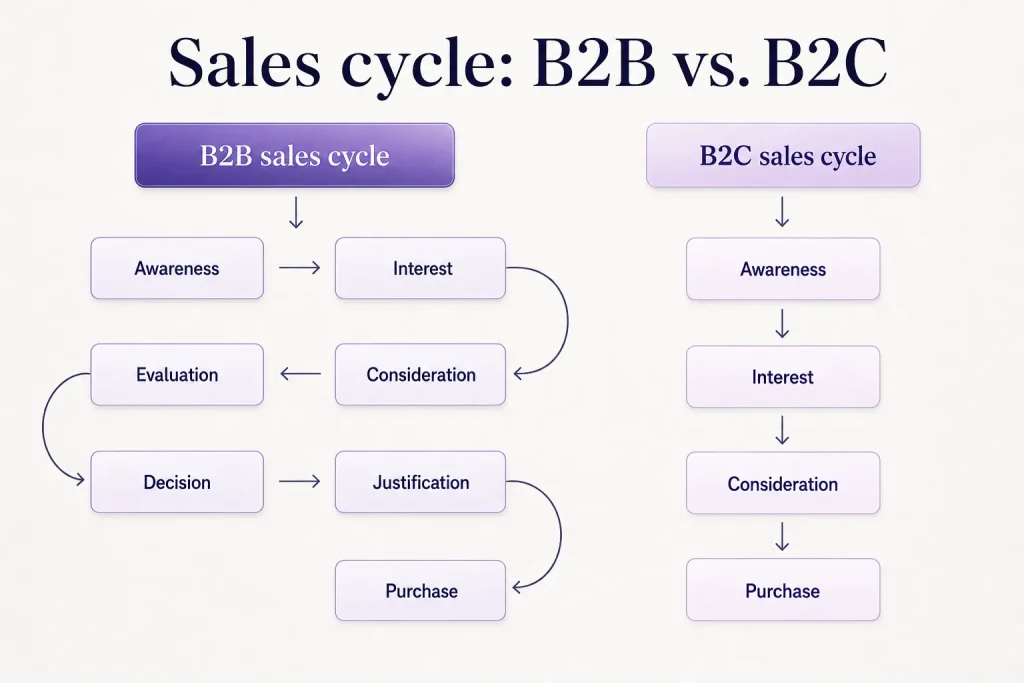
- Consider your sales cycle length — shorter cycles often favor paid ads and retargeting, while longer cycles benefit from educational content like blogs and case studies
- Factor in AI search, since a growing share of buyers now use AI tools to research products and make decisions
- Weigh your budget and timeline, balancing paid channels (faster but ongoing cost) with unpaid channels (slower but longer-lasting)
Step 5: Define Your Content Plan
Your content plan connects your themes to the channels you’ve chosen. Start by identifying three to five core themes your brand should be known for, based on your research and positioning.
Then map each theme to your channels, considering:
- Intent – what the buyer is trying to accomplish
- Format – what type of content fits that channel
- Next step – what you want the reader to do after engaging
Once mapped, add your strongest ideas to a content calendar with a theme, channel, format, goal, owner, and target publish date for each piece.
Step 6: Set Your Budget
Your budget should cover everything needed to execute your plan — ad spend, content production, tools, freelancers, and reporting. List each cost as one-time or recurring, then allocate funds based on priority.
If budget is tight, focus spending on the channels and content most directly tied to your primary goal. Also set aside budget for analytics tools so you can actually measure what’s working.
Step 7: Activate Your Plan and Track Results
Once your strategy is live, track metrics tied directly to your original goal. Depending on your channels, this might include:
- Organic clicks and qualified leads from SEO
- Cost per lead and conversions from paid search
- Click rates and demo requests from email campaigns
- Brand mentions and citations in AI-generated answers
Tools like Google Search Console, Google Analytics, and AI visibility platforms can help you monitor performance across channels and adjust as needed.
Marketing Strategy Checklist
- Before launching your strategy, ensure you have completed the following:
- ✔ Defined SMART marketing goals
- ✔ Identified your target audience
- ✔ Researched competitors
- ✔ Selected appropriate marketing channels
- ✔ Created a content plan
- ✔ Established a realistic budget
- ✔ Defined key performance indicators (KPIs)
- ✔ Scheduled regular performance reviews
How AI Is Transforming Marketing Strategy
- Artificial Intelligence is changing how businesses develop and execute marketing strategies. AI-powered tools can analyze customer behavior, suggest content ideas, predict trends, and automate repetitive tasks. Search engines also use AI to deliver more relevant results, making it important to create helpful, trustworthy, and well-structured content.
- Businesses that combine human creativity with AI insights can improve efficiency while delivering more personalized customer experiences.
Learn Digital Marketing at DigitalX Marketers Academy
- Building an effective marketing strategy requires practical knowledge of SEO, social media marketing, paid advertising, content marketing, analytics, and AI-powered marketing tools. At DigitalX Marketers Academy, students gain hands-on experience through live projects, industry-focused training, and expert mentorship. If you’re looking for a Digital Marketing Academy in Kochi or a Digital Marketing Course in Kochi, our programs are designed to help you develop job-ready skills and confidently create marketing strategies that drive measurable business growth.
Conclusion
An effective marketing strategy is the base of every successful company. Using these seven strategies—setting your objectives, knowing your target audience, identifying the competition, selecting the right channels, producing high-quality content, allocating the budget, and measuring the performance—you will be able to develop an effective marketing strategy that brings sustainable growth. With the continuous development of digital marketing, including AI technologies, regular evaluation of your marketing strategy will be key to your success.
Frequently Asked Questions
What is a marketing strategy?
A marketing strategy is the overall approach a business uses to reach its target audience and convert them into customers. It sets the direction, while a marketing plan outlines the specific tactics used to execute it.
How do I create a marketing strategy from scratch?
Start by setting a SMART goal, then research your market, define your positioning and messaging, choose the right channels, build a content plan, set a budget, and track results against your original goal.
What's the difference between a marketing strategy and a marketing plan?
A marketing strategy defines the overall direction and goals, while a marketing plan lists the specific actions, content, and campaigns used to carry out that strategy.
What are the 7 steps to create a marketing strategy?
The seven steps are: set clear goals, research the market, define your positioning and messaging, choose your marketing channels, define your content plan, set your budget, and activate your plan while tracking results.